
Home / Types of Shutters / Plantation
Type 01 · interior · basswood + PVC
Plantation shutters Newcastle
Specified per room, not per catalogue page. Material by exposure, louvre width by light, tilt by the era of your windows. Made to measure for each opening and installed square.
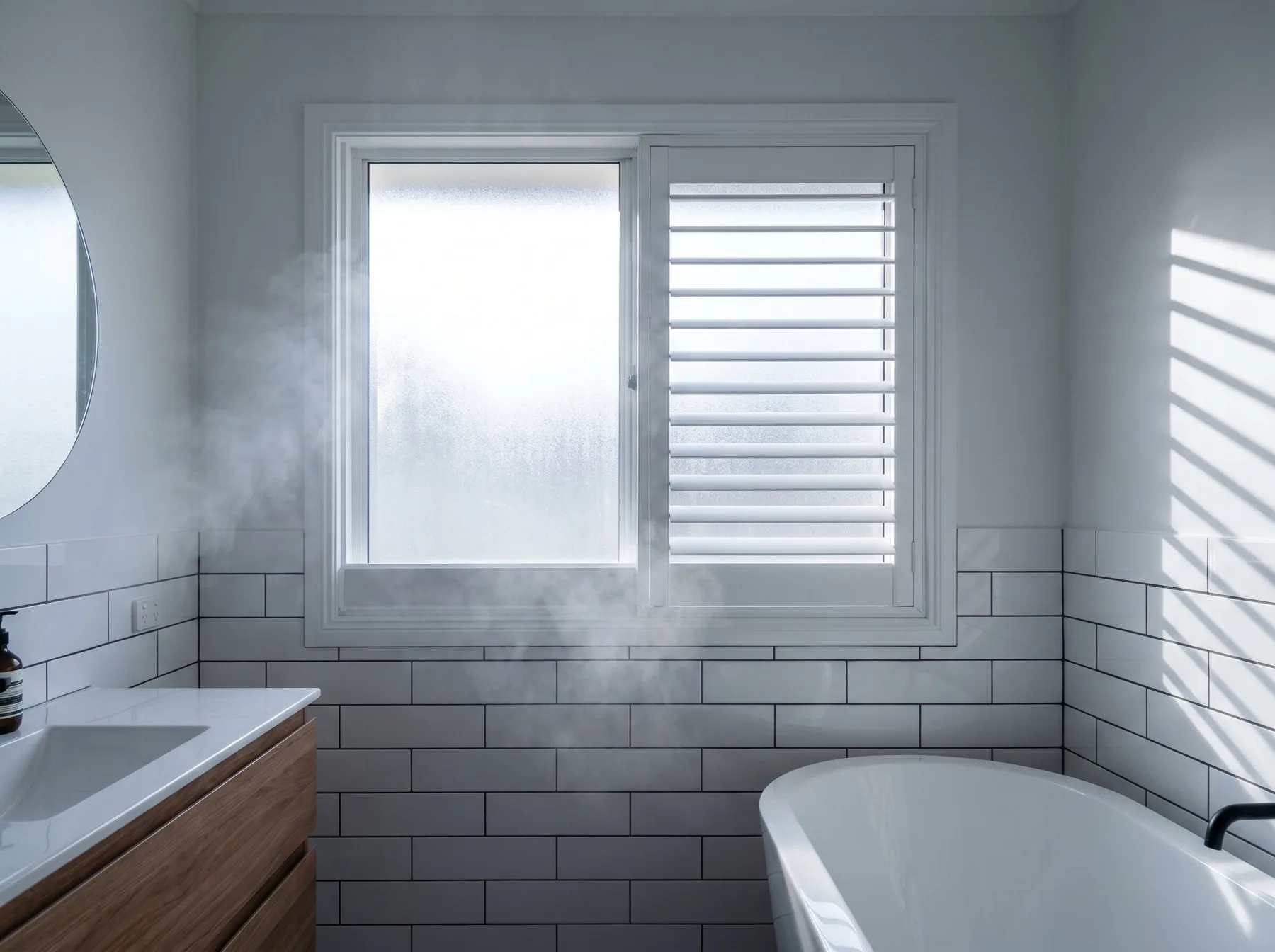
Basswood in the front rooms. PVC where the steam is.
Two materials cover nearly every indoor window in Newcastle, and the room decides between them, not the brochure.
| Room | Spec | Because |
|---|---|---|
| Living, dining, bedrooms | basswood | Light, stable joinery timber that takes paint beautifully and stays crisp at wide blade widths. |
| Bathroom, ensuite, laundry | PVC | Steam doesn't argue with PVC. It cannot swell, flake or sulk over a shower. |
| Kitchens | PVC or basswood | Splash zone near the sink says PVC; a dining-side window can stay timber. |
| Salt-band homes (within ~2 km of the surf) | PVC, aluminium-reinforced | This close to the break even indoor timber can sulk. A stiffened PVC blade holds straight. |
Wide PVC blades over ~760 mm span get an aluminium core as standard practice, so they never bow.
Why basswood, not "hardwood"?
Basswood is the joinery trade's shutter timber: straight-grained, light enough that big panels don't strain their hinges, and stable enough to keep its line through Newcastle's humid summers. Heavier hardwoods look impressive on a sample and droop on a hinge.
63, 89 or 114 mm. The decision you'll look at every day.
Same window, three characters. Narrow blades read traditional and close tight lines; wide blades open the sightline and let more sky through the same opening.
Close neighbour, small sash: narrow.
Tightest closed lines and the most traditional read. The pick where privacy beats view and the opening is modest.
In doubt? 89.
The balance point of light, privacy and cleaning ease. If a home mixes widths, 89 usually carries the main rooms.
A view worth keeping: wide.
Fewest blades across the glass, biggest clear gaps when open. Made for ocean outlooks and full-height modern windows.
The full trade-offs, with the mistakes we see: the louvre width guide.
Front tilt for the sashes. Hidden tilt for the clean line.
Front tilt is the visible rod down the face of the blades: the traditional look, correct on a double-hung sash in a Cooks Hill terrace or a Hamilton cottage. Hidden tilt moves the gearing into the stile, so the blades read as one uninterrupted plane: the modern default, and the easy-wipe choice in wet rooms.
Period window, front tilt. New build, hidden. Mixed house, decide room by room.
The frame does the quiet work. A Z-frame wraps the reveal and covers out-of-square plaster (most older Newcastle reveals are out by more than you'd think). An L-frame sits flush for clean modern reveals or face-mounting. At the measure we check each reveal for square and spec the frame per window, not per house.

Stackers, sliders and walls of glass.
Bi-fold panels
Panels hinge to each other and concertina to one or both sides. The whole opening clears when you want it open: the pick for alfresco stackers you actually walk through.
Bypass (sliding) panels
Panels slide past each other on a top track. Nothing swings into the room, so it suits wardrobes, room dividers and tight spaces where a hinged panel would collide with life.
Past a comfortable reach, or across a really long run, the honest answer is a motor: motorised shutters, specified.
Plantation questions, answered straight
What do plantation shutters cost?
Per home, not per price list: openings, sizes, material and frames set the figure. The in-home measure and written quote are free, and nothing is made until the measure confirms every dimension.
Reveal fit or face fit?
Reveal fit where the reveal allows it.
Inside the reveal reads built-in and keeps the architrave visible. Face fit earns its place when the reveal is too shallow or the window furniture is in the way. It's a per-window call at the measure.
Will they suit an older home's windows?
Yes, and this is where spec matters most: front tilt, a frame that respects the architrave, and panels sized to the sash proportions. We work with your home's character rather than over it. See shutters in the older streets.
How do I clean them?
A microfibre wipe along the blades, occasionally damp on PVC. No soaking, no solvents. The full routine is in the cleaning guide.
Are the louvres safe for kids' rooms?
Shutters carry no looped cords, which is exactly why they're a common pick for children's bedrooms; corded internal window coverings are regulated in Australia for strangulation risk. Tilt is by rod or hidden gear, nothing dangles. See the ACCC's guidance on blind and curtain cord safety linked in our care guide.
Free in-home measure & quote
Every window is bespoke. The quote starts at your place, not ours.
A specialist measures each opening, talks through material, louvre width and tilt for your rooms and your exposure, and leaves you a written quote. Nothing is made until the figures are checked on site.
Form only. We reply to arrange a time that suits.